

A noun-first method for building existence questions with is there, are there, a, an, or any—plus clear answers and search-query repairs.

Use is there before a singular countable noun or an uncountable noun: “Is there a problem?” “Is there any water?” Use are there before a plural noun: “Are there any problems?” The word there introduces the existence or presence of something; it does not decide the verb by itself—the following noun does.
“Is there” is therefore a beginning, not usually a complete question. The listener needs to know what may exist and often where, when, or under which condition.
Choose the verb from the following noun
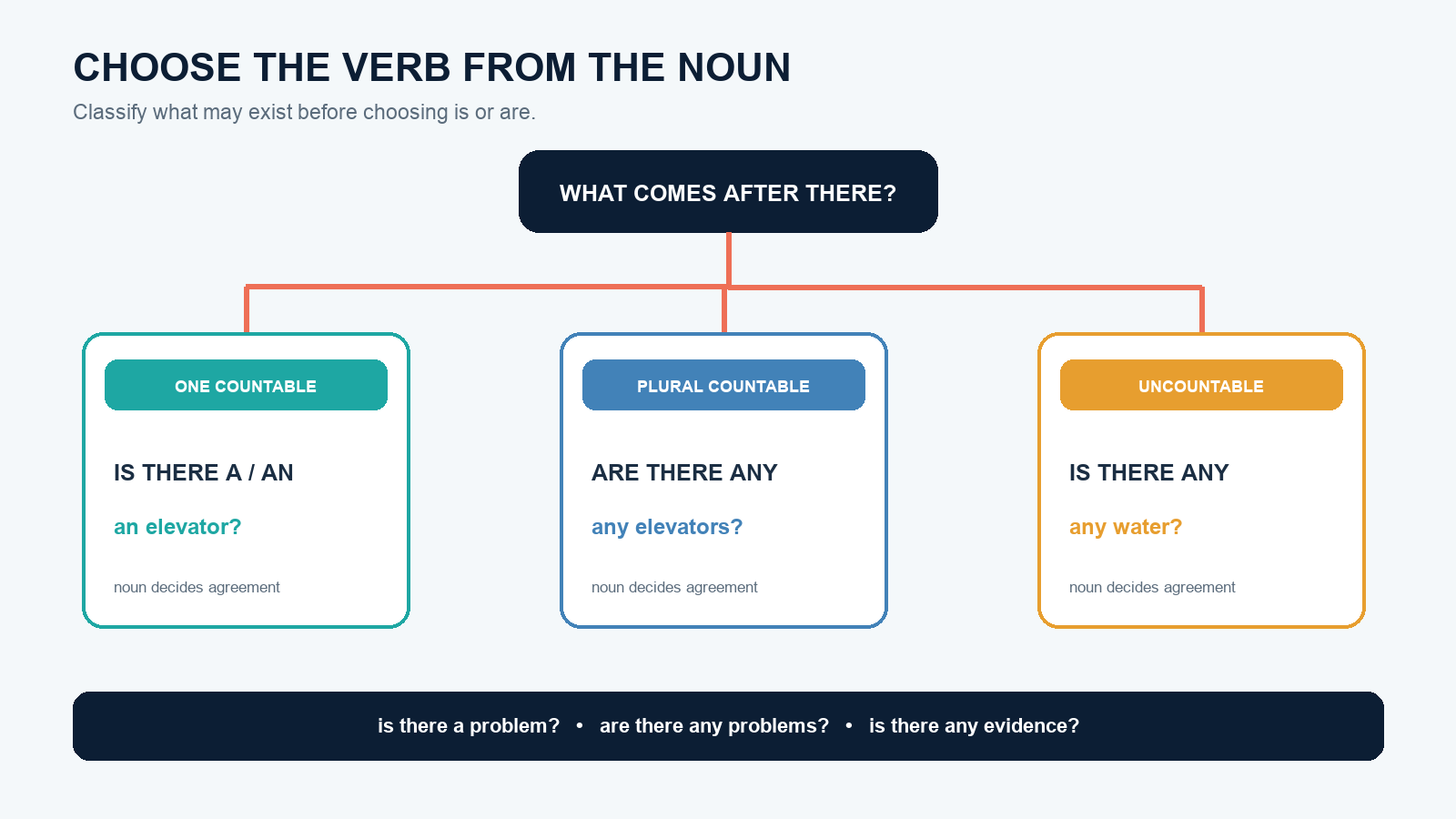
| Noun type | Question pattern | Example |
|---|---|---|
| One singular countable thing | Is there a/an + noun? | Is there an elevator? |
| More than one countable thing | Are there any/number + plural noun? | Are there any elevators? |
| Uncountable substance or idea | Is there any + uncountable noun? | Is there any evidence? |
| A specific known thing | Is there the + specified noun? | Is there the option we discussed? |
The British Council’s there is/there are grammar guide gives the same agreement rule: is there for singular and uncountable nouns, and are there for plural nouns. Cambridge explains that these forms introduce the existence or presence of someone or something, often when it is first mentioned.
A noun can change category with meaning. “Is there chicken in the soup?” treats chicken as food and therefore uncountable. “Is there a chicken in the yard?” asks about one animal. Decide what the noun means in the sentence, not just how it is spelled.
Choose a, an, any, or no determiner
Use a/an with one nonspecific countable noun:
- Is there a pharmacy nearby?
- Is there an ATM in the station?
Choose a or an from the next sound, not simply the next written letter. The British Council’s indefinite-article reference gives “a university” because it begins with a /y/ sound and “an hour” because the initial h is silent.
Use any for an open question about an uncountable amount or an unknown plural quantity:
- Is there any milk?
- Are there any seats?
Use no in a statement, not after not: “There is no signal” or “There isn’t any signal.” Avoid the double negative “There isn’t no signal” in standard formal English.
Build the complete question in six slots
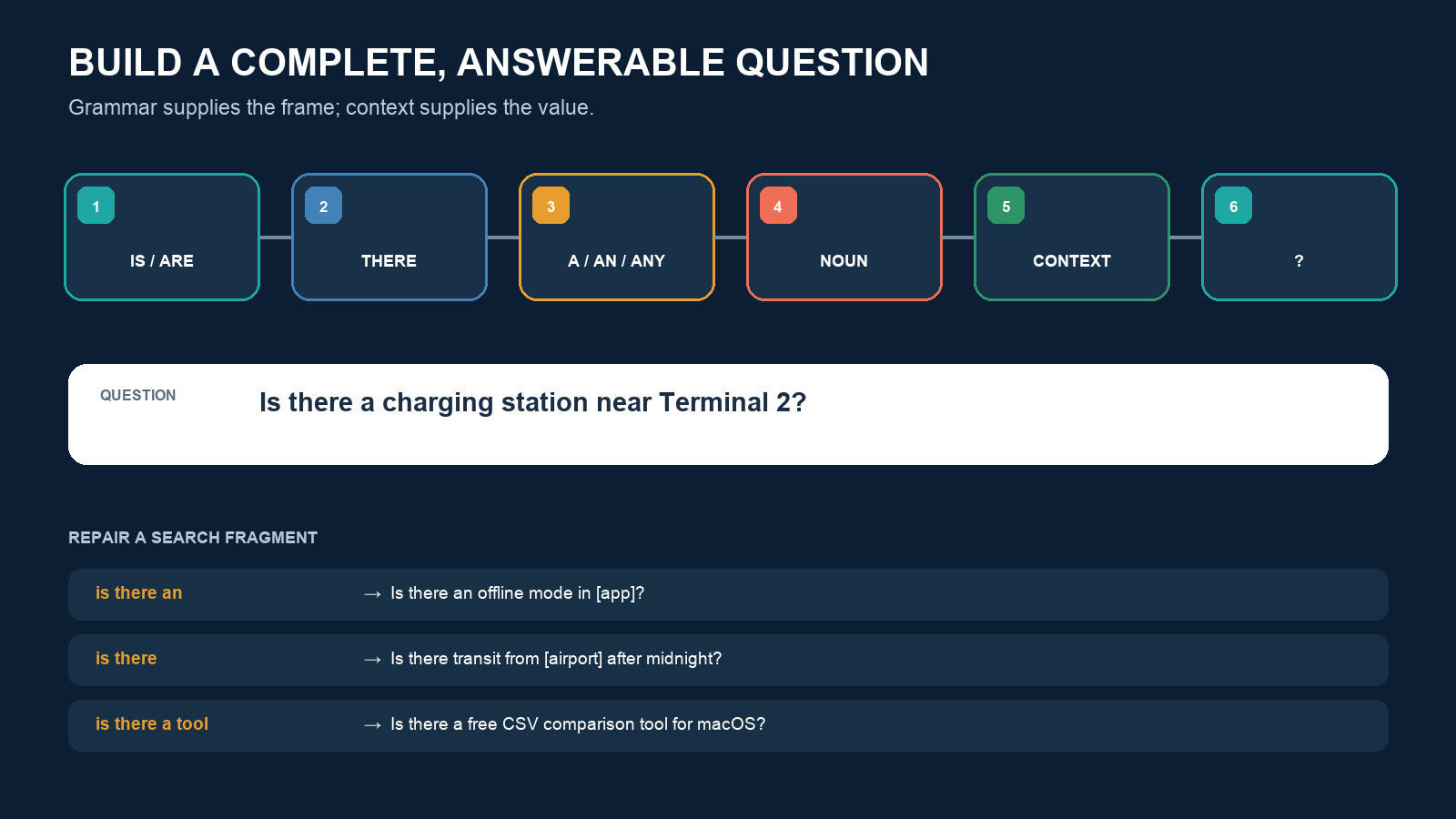
Use this frame:
[Is/Are] + there + [a/an/any/number] + [noun] + [place, time, or condition] + ?
Build it left to right:
- Target noun: charging station
- Count: one nonspecific station
- Agreement: is
- Article: a
- Useful place: near Terminal 2
- Final question: Is there a charging station near Terminal 2?
For a plural target, the same method produces “Are there any charging stations near Terminal 2?” The singular question asks whether at least one exists; the plural question leaves the number open and may invite a list.
Answer with matching agreement
Mirror the verb and number in a short answer:
| Question | Positive answer | Negative answer |
|---|---|---|
| Is there a fee? | Yes, there is. | No, there isn’t. |
| Is there any parking? | Yes, there is. | No, there isn’t. |
| Are there any fees? | Yes, there are. | No, there aren’t. |
Do not answer “Yes, there’s” as a complete short answer. The contracted form there’s normally needs material after it, such as “Yes, there’s one near the entrance.” The British Council specifically models “Yes, there is” and “Yes, there are.”
Move the structure through time and possibility
The same existential structure can use other forms of be or a modal:
- Past singular: Was there a delay?
- Past plural: Were there any delays?
- Future: Will there be a recording?
- Present perfect: Has there been an update? / Have there been any updates?
- Possibility: Could there be another cause?
- Necessity: Does there need to be a signature?
Keep the noun agreement visible in compound forms: has there been pairs with a singular event or uncountable change; have there been pairs with plural events.
Keep existential there separate from location there
In “Is there a bank near here?”, the first there is a grammatical subject introducing existence. In “Is the bank there?”, there points to a location. The word order changes the question:
- Is there a bank? Does a bank exist or is one present?
- Is the bank there? Is a known bank in that location?
Also keep there separate from their (possessive) and they’re (they are). They sound alike but cannot replace one another.
Repair is there as a search query
A search for only “is there” has almost no topic. Add the entity, need, place, and a constraint that would change the answer:
| Weak fragment | Answerable query | What improved |
|---|---|---|
| is there an | Is there an offline mode in [app name]? | Feature and product |
| is there | Is there public transit from [airport] after midnight? | Route and time constraint |
| is there a tool | Is there a free tool to compare two CSV files on macOS? | Task, price, and platform |
| are there | Are there size limits for PDF uploads in [service]? | Object and service |
If you already know the feature exists and need instructions, replace the existence question with an action query: “How to enable offline mode in [app].” If the answer can change, add a date or version and prefer the official documentation.
Run the noun-first check
Repair “Is there any restaurants near the hotel?” by finding the noun first. Restaurants is plural, so the verb must be are: “Are there any restaurants near the hotel?”
Repair “Are there an elevator?” the same way. An elevator is one singular countable noun, so write “Is there an elevator?” The final check is always the same: classify the noun, match the verb, choose the determiner, then add enough context for a useful answer.