
One pound contains exactly 16 avoirdupois ounces. Use the right formula for total ounces, decimal pounds, mixed notation, or spreadsheet data.
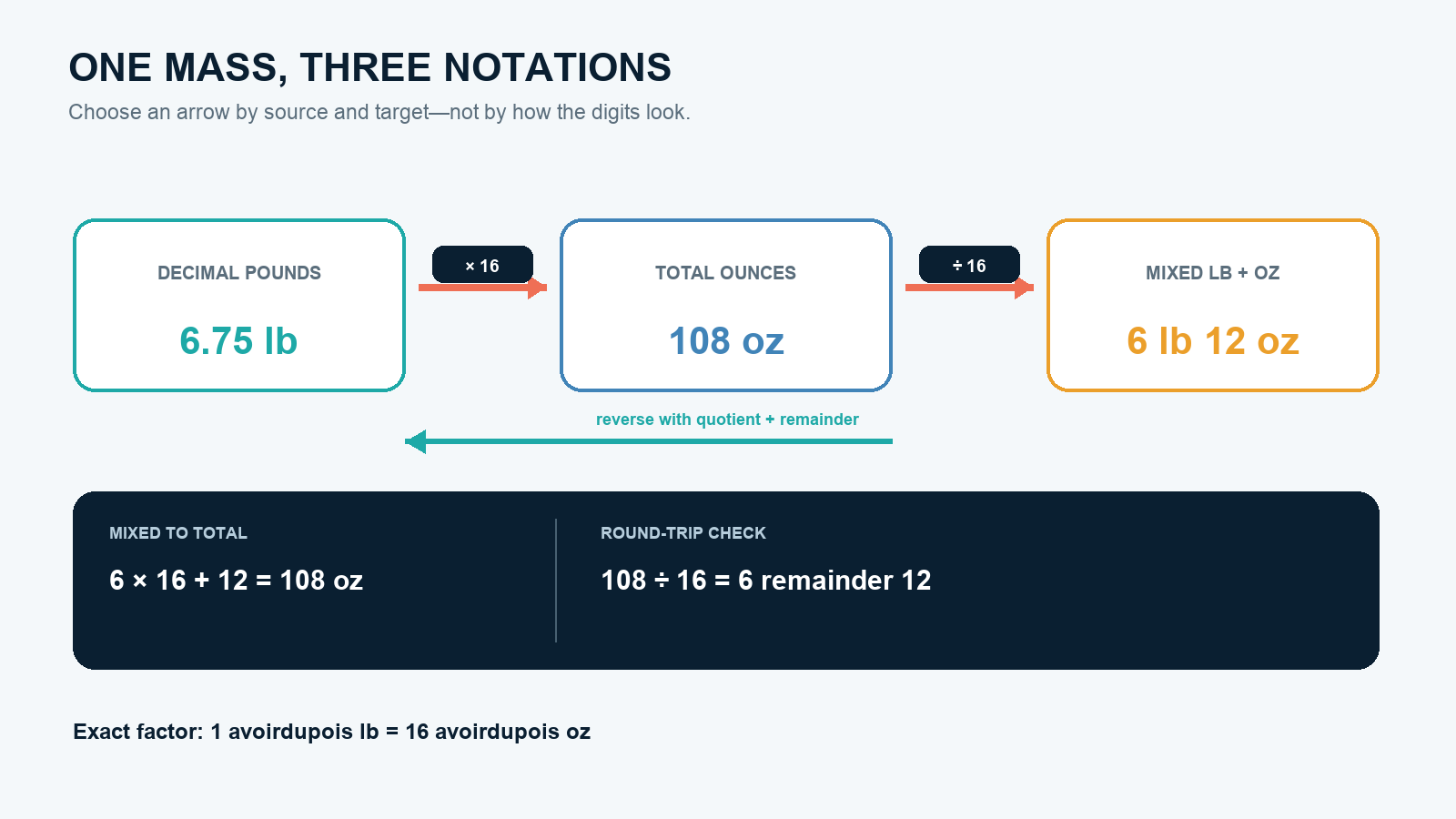
There are exactly 16 avoirdupois ounces (oz) in 1 pound (lb). Multiply pounds by 16 to get total ounces. Divide total ounces by 16 to get decimal pounds, or use the whole-number quotient as pounds and the remainder as ounces.
The arithmetic is easy; the notation causes most errors. 6 lb 12 oz, 6.75 lb, and 108 oz are the same mass. By contrast, 6.12 lb is not shorthand for 6 lb 12 oz. The digits after a decimal point are a fraction of a pound, not an ounce field.
Choose the formula that matches the input
| You have | You need | Formula | Example |
|---|---|---|---|
| Pounds | Total ounces | oz = lb × 16 | 6.75 × 16 = 108 oz |
| Total ounces | Decimal pounds | lb = oz ÷ 16 | 108 ÷ 16 = 6.75 lb |
| Mixed lb + oz | Total ounces | oz = lb × 16 + leftover oz | 6 × 16 + 12 = 108 oz |
| Total whole ounces | Mixed lb + oz | whole quotient + remainder | 108 ÷ 16 = 6 remainder 12 |
NIST Handbook 44’s current mass table lists 1 avoirdupois pound as exactly 16 avoirdupois ounces. It also gives the exact SI relationships: 1 lb = 0.45359237 kg and 1 oz = 0.028349523125 kg. Because the pound-ounce factor is exact, any rounding in an answer comes from the measured input or chosen display precision, not from 16.
Convert mixed pounds and ounces without losing the remainder
Suppose a scale reads 2 lb 5 oz. Convert the whole pounds first, then add the leftover ounces:
(2 × 16) + 5 = 37 oz
To reverse 37 oz, ask how many complete groups of 16 it contains. Two groups account for 32 oz, leaving 5 oz:
37 oz = 2 lb 5 oz
Use the same check on a larger value. For 85 oz, 5 complete pounds account for 80 oz and the remainder is 5 oz, so 85 oz = 5 lb 5 oz. Converting back gives 5 × 16 + 5 = 85, which verifies both the quotient and remainder.
If total ounces include a decimal, keep the decimal remainder unless the task provides a rounding rule. For 37.6 oz, the result is 2 lb 5.6 oz, or 2.35 lb. Do not silently round it to 2 lb 6 oz; that changes the reported measurement.
Translate decimal pounds into lb + oz
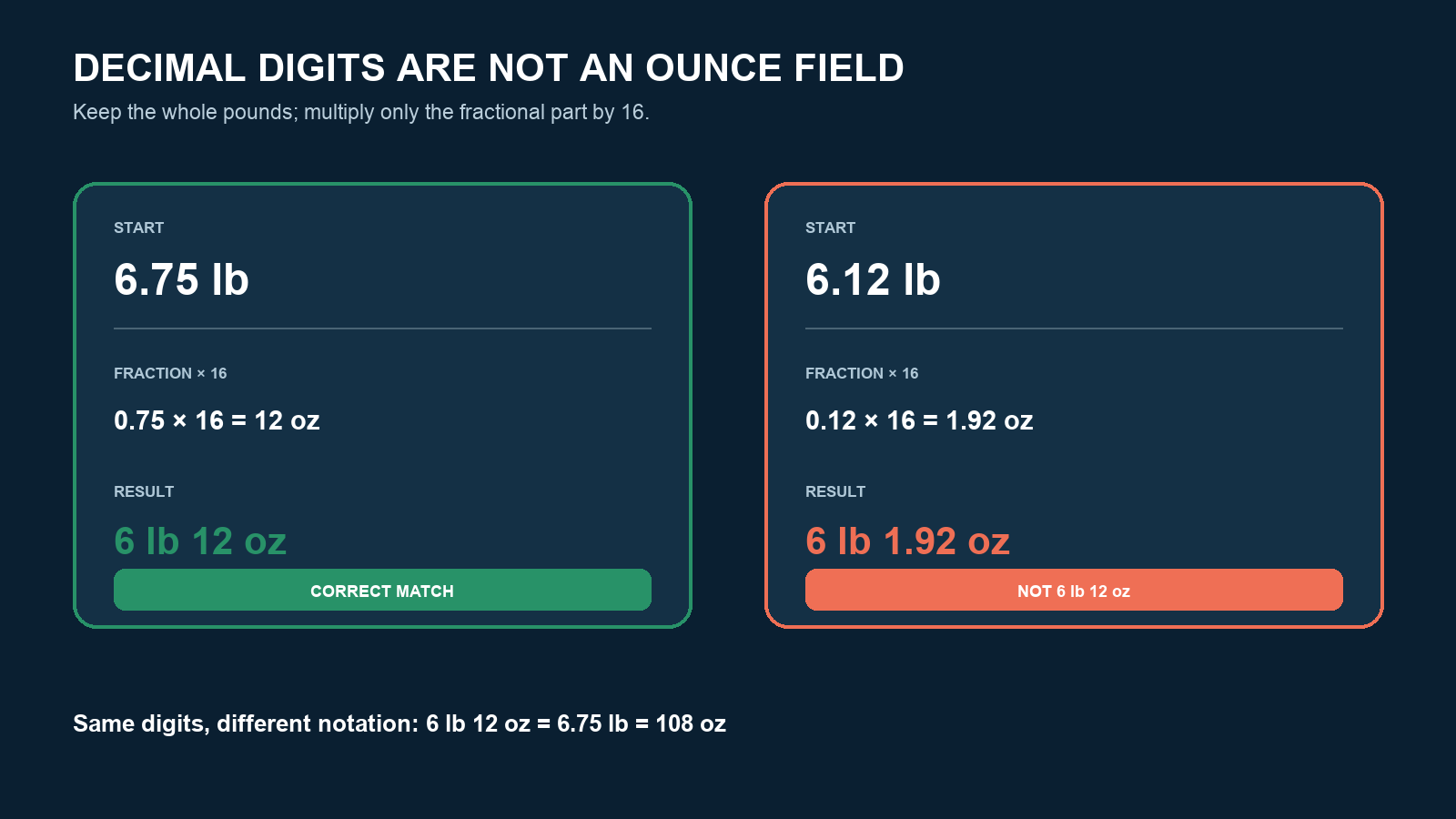
Separate the whole and fractional parts. For 6.75 lb:
- Keep the 6 whole pounds.
- Multiply the fractional part: 0.75 × 16 = 12 oz.
- Report 6 lb 12 oz.
Now compare 6.12 lb. Its fractional part is 0.12, so 0.12 × 16 = 1.92 oz. Therefore 6.12 lb = 6 lb 1.92 oz, not 6 lb 12 oz. The written dot means decimal notation; unit labels beside two separate fields mean mixed notation.
Use the fractional-pound shortcut table
Common binary fractions of a pound convert cleanly because the denominator divides 16:
| Fraction of a pound | Decimal pound | Ounces |
|---|---|---|
| 1/16 lb | 0.0625 lb | 1 oz |
| 1/8 lb | 0.125 lb | 2 oz |
| 1/4 lb | 0.25 lb | 4 oz |
| 3/8 lb | 0.375 lb | 6 oz |
| 1/2 lb | 0.5 lb | 8 oz |
| 5/8 lb | 0.625 lb | 10 oz |
| 3/4 lb | 0.75 lb | 12 oz |
| 7/8 lb | 0.875 lb | 14 oz |
For any other fraction, multiply by 16. For example, 1/3 lb × 16 = 5.333… oz. How many digits to keep depends on the measurement and its purpose, not on the exactness of the conversion factor.
Put the conversion into a spreadsheet
Assume cell A2 contains whole pounds, B2 contains leftover ounces, and C2 contains total ounces:
| Task | Excel formula | Result with example |
|---|---|---|
| Mixed lb + oz to total oz | =A2*16+B2 |
A2=2, B2=5 → 37 |
| Total oz to decimal lb | =C2/16 |
C2=37 → 2.3125 |
| Whole pounds from whole oz | =QUOTIENT(C2,16) |
C2=37 → 2 |
| Leftover ounces from whole oz | =MOD(C2,16) |
C2=37 → 5 |
Microsoft documents that QUOTIENT returns the integer portion of a division and that MOD returns the remainder. Those two outputs correspond directly to whole pounds and leftover ounces when the total-ounce input is a nonnegative whole number.
Validate inputs before automating. A value such as “2.5” in the leftover-ounce column may be legitimate precision, but a value of 18 oz should normally be normalized to 1 additional pound and 2 oz. Blank cells, text labels, negative values, and rounding rules need explicit handling in a production sheet.
Do not mix mass ounces with other ounces
The 16-to-1 rule is for avoirdupois mass, the system used for ordinary body weight, groceries, parcels, and many household objects in the United States. It does not mean:
- Fluid ounces: a volume unit. Converting a liquid volume to mass requires the substance’s density and relevant conditions.
- Troy ounces: a different mass unit used for precious metals. A troy pound contains 12 troy ounces, not 16 avoirdupois ounces.
- Ounce-force: a force unit, not the ordinary mass value on a kitchen or parcel scale.
NIST’s Metric Household guidance separates kitchen capacity measures such as fluid ounces from mass, and its unit tables label avoirdupois and troy systems separately. Preserve the full unit name whenever the context could be ambiguous.
Match rounding to the measurement
An exact conversion cannot add precision to a coarse measurement. If a scale reports only to the nearest ounce, converting 37 oz to 2.3125 lb does not prove the object was measured to four decimal places of a pound. Keep enough digits for calculation, then round once at the end to the resolution or rule the task actually requires.
For a reliable final check, keep three equal forms together: 6 lb 12 oz = 6.75 lb = 108 oz. Convert the result back to the original format. If the round trip does not reproduce the starting value apart from an intentional rounding step, the input format or arithmetic is wrong.