
Percentage problems become simple once you label the part, whole, and percent, then rearrange the relationship part = decimal percent × whole.
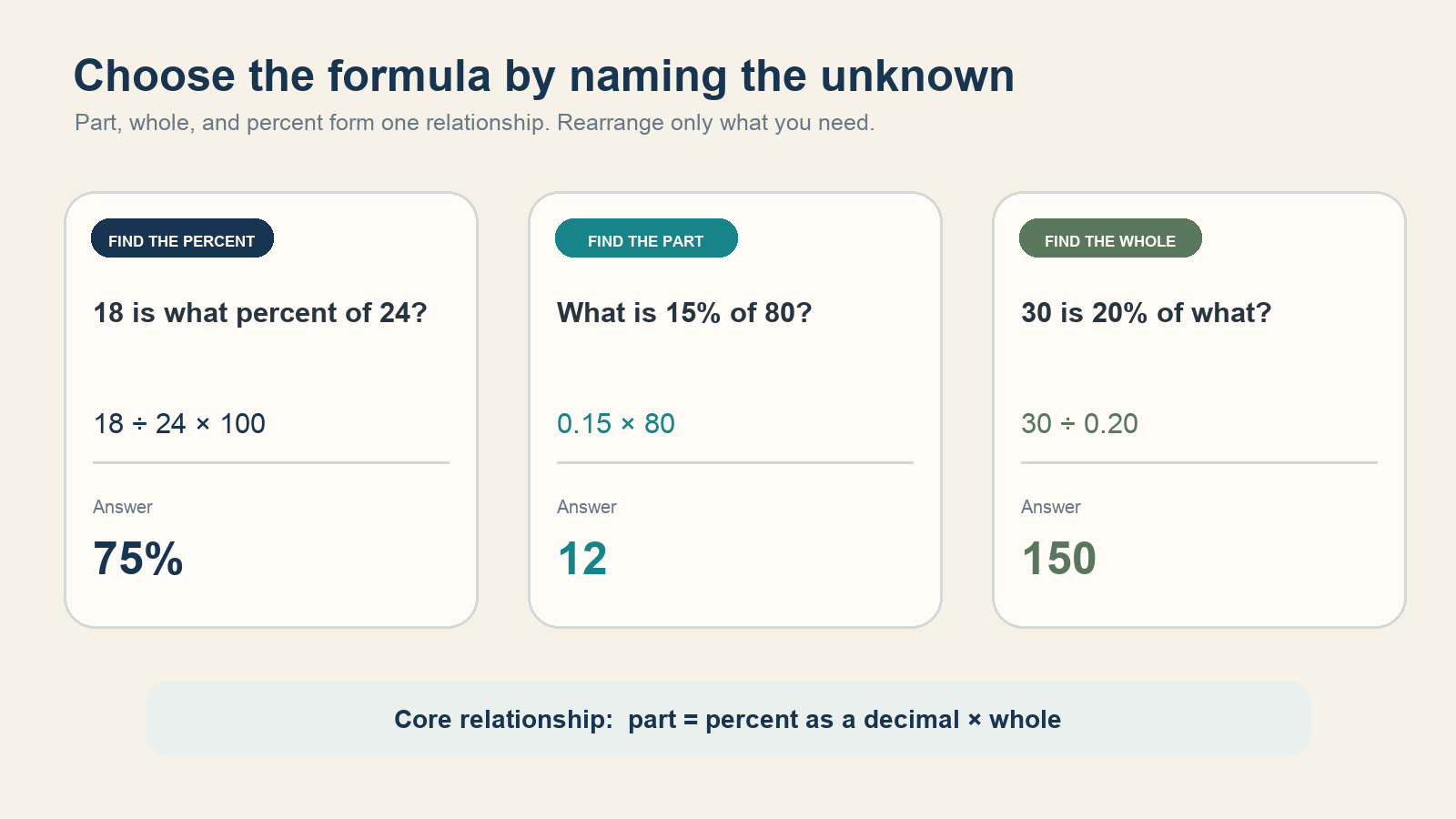
To calculate what percentage one number is of another, divide the part by the whole and multiply by 100. For example, 18 out of 24 is 18 ÷ 24 × 100 = 75%. To find a percentage of a number instead, convert the percentage to a decimal and multiply: 15% of 80 is 0.15 × 80 = 12.
Most percentage questions are rearrangements of one relationship: part = percent as a decimal × whole. The reliable method is to label the part, whole, and percent before choosing an operation.
What does percentage mean?
Percent means “per hundred.” Therefore 27% means 27 out of 100, which is the fraction 27/100 and the decimal 0.27. OpenStax’s percent lesson expresses the same relationship as part = percent × total, with the percent written in decimal form.
| Percent | Decimal | Fraction |
|---|---|---|
| 5% | 0.05 | 5/100 = 1/20 |
| 25% | 0.25 | 25/100 = 1/4 |
| 100% | 1 | 100/100 = 1 |
| 125% | 1.25 | 125/100 = 5/4 |
A percentage can be below 0% or above 100%. A negative percentage can describe a signed change, while 125% means 1.25 times the reference amount. The % symbol represents 0.01; NIST’s SI style guide describes it as the number one hundredth.
Choose the formula by identifying the unknown
1. Find what percent one number is of another
Percent = part ÷ whole × 100
Question: 18 is what percent of 24?
- Part = 18; whole = 24.
- Divide: 18 ÷ 24 = 0.75.
- Multiply by 100: 0.75 × 100 = 75%.
The whole is the reference amount. Reversing the numbers gives 133.33%, which answers a different question: 24 is what percent of 18?
2. Find a percentage of a number
Part = percent as a decimal × whole
Question: What is 15% of 80?
- Convert 15% to 0.15 by dividing by 100.
- Multiply: 0.15 × 80 = 12.
The word of usually signals multiplication. This same formula calculates a tip, sales tax, discount amount, commission, or percentage allocation.
3. Find the whole when the part and percent are known
Whole = part ÷ percent as a decimal
Question: 30 is 20% of what number?
- Convert 20% to 0.20.
- Divide: 30 ÷ 0.20 = 150.
- Check: 20% of 150 = 30.
Calculate percentage increase or decrease
Use the original value as the reference:
Percentage change = (new value − old value) ÷ old value × 100
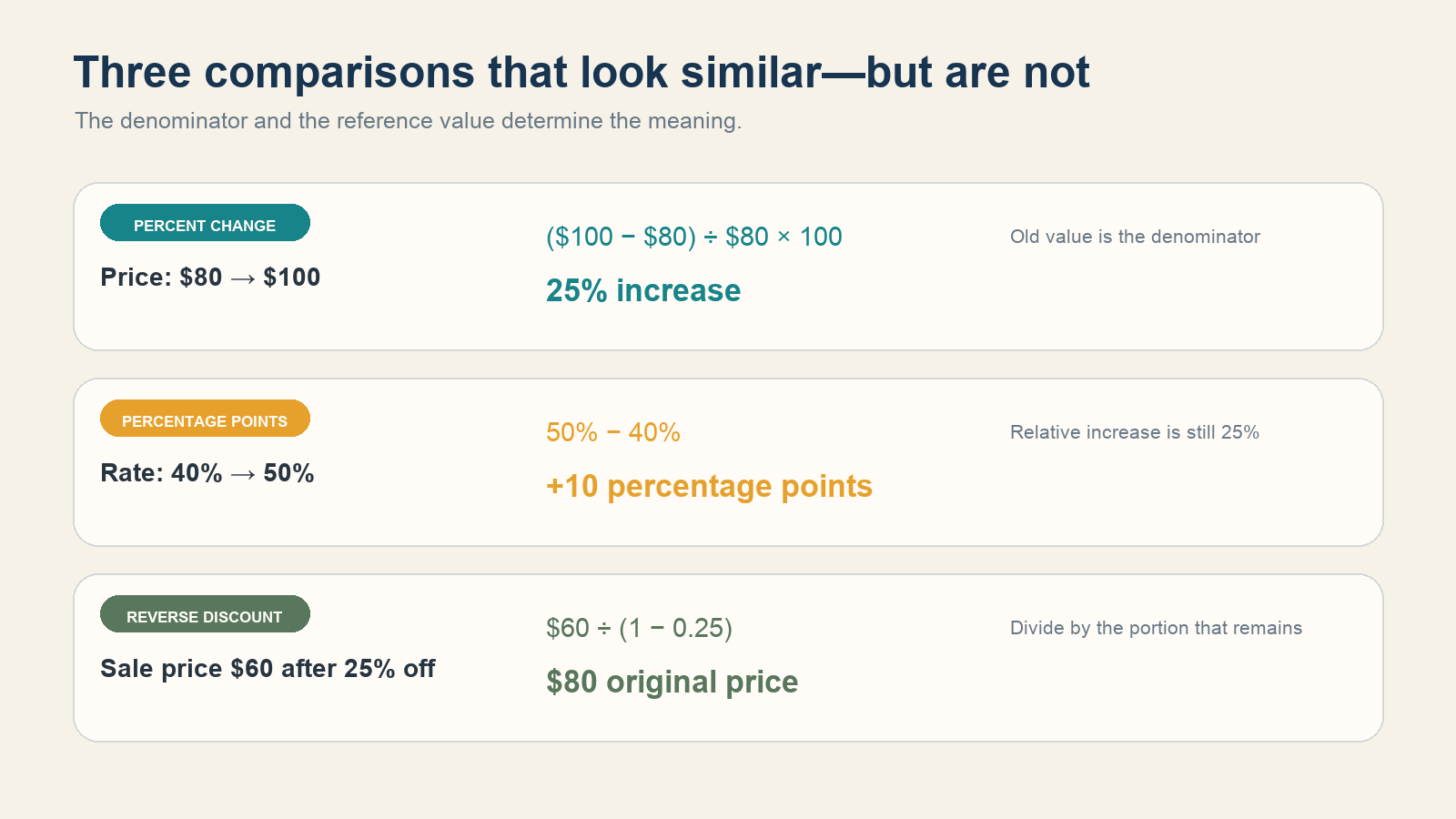
If a price rises from $80 to $100, the difference is $20. Divide by the old $80: 20 ÷ 80 = 0.25, so the price increased by 25%.
If it falls from $100 to $80, the change is −$20. Divide by the old $100: −20 ÷ 100 = −20%, or a 20% decrease. The increase and decrease are not symmetrical because their starting values differ. A 25% increase followed by a 25% decrease does not return to the original value: $80 × 1.25 × 0.75 = $75.
Percentage change vs percentage points
When comparing two percentages, subtraction gives the change in percentage points. If a response rate moves from 40% to 50%, it increases by 10 percentage points.
The relative percentage increase is different:
(50% − 40%) ÷ 40% × 100 = 25%
So the same move is both a 10-percentage-point increase and a 25% relative increase. State which measure you mean; writing only “a 10% increase” is ambiguous and, in this example, incorrect under the relative-change definition.
Work with discounts, markups, tax, and tips
For a 25% discount on an $80 item:
- Discount = $80 × 0.25 = $20.
- Sale price = $80 − $20 = $60.
- Shortcut: $80 × (1 − 0.25) = $60.
To reverse the discount when only the sale price is known, divide by the percentage that remains. A 25% discount means the customer paid 75%, so $60 ÷ 0.75 = $80. Dividing $60 by 0.25 would find a number of which $60 is 25%, not the original price.
For an increase such as tax, tip, or markup, use original × (1 + rate). An $80 bill plus 15% is $80 × 1.15 = $92. OpenStax’s discount and sales-tax examples use the same decimal-rate structure.
Use a calculator or spreadsheet without double-multiplying
On a basic calculator, 42 ÷ 50 × 100 returns 84. Add the % sign when writing the answer. To calculate 18% of 250, enter 0.18 × 250.
In Excel or Google Sheets, store 18% as 18% or 0.18; both represent the decimal 0.18 when the cell is formatted correctly. Useful formulas include:
=A2/B2to find the part as a fraction of the whole, then format as Percentage.=B2*C2to find an amount when C2 contains a percentage.=(C2-B2)/B2to find percentage change from B2 to C2.
Microsoft’s percentage-format guide warns that formatting an existing value of 10 as a percentage displays 1000%, because the stored value should have been 0.10 for 10%. Do not multiply by 100 in the formula and then also apply percentage formatting.
Check the denominator and edge cases
- Part-to-whole percentage: the whole cannot be zero; division by zero is undefined.
- Change from zero: a conventional percentage increase from 0 to a positive value is undefined because the old-value denominator is zero. Report the absolute change instead.
- Different units: convert both quantities to the same unit before dividing.
- Rounding: keep extra digits during the calculation and round only the final answer.
- Changing groups: a percentage comparison can mislead if the underlying population, time window, or measurement rule changed.
The quickest reliable check is to reconstruct the relationship: part should equal decimal percent × whole. If it does, the arithmetic is internally consistent; then confirm that the chosen whole really is the reference the question intended.