

A noun names or refers to an entity, place, quality, state, idea, or action and can head a noun phrase. Meaning helps, but sentence behavior is the stronger test.
A noun is a word that names or refers to a person, animal, place, object, quality, state, idea, or action. Nouns can head noun phrases and commonly serve as a subject, object, complement, or object of a preposition. Examples include teacher, London, book, honesty, peace, and running. A noun may be common or proper, concrete or abstract, and countable or uncountable.
In “The curious student carried two books into the library,” the head nouns are student, books, and library. Their complete noun phrases perform three different jobs: subject, direct object, and object of the preposition into.

Go beyond person, place, or thing
“A noun names a person, place, or thing” is a useful starting rule, provided thing is understood broadly. A noun can refer to something physical—river, phone, Amina—or to something that cannot be touched—patience, risk, silence, arrival, or democracy.
Cambridge’s grammar entry on nouns places nouns among the four major English word classes and includes people, animals, material things, ideas, feelings, and situations. Merriam-Webster’s definition also covers qualities, states, concepts, and actions and notes that a noun is not always one word.
Meaning alone is not enough. Run names an action in “The morning run was difficult,” but it is a verb in “They run every morning.” The sentence tells you which grammatical job the word is doing.
Use four clues to identify a noun
No single trick catches every English noun. Combine several clues and allow for exceptions.
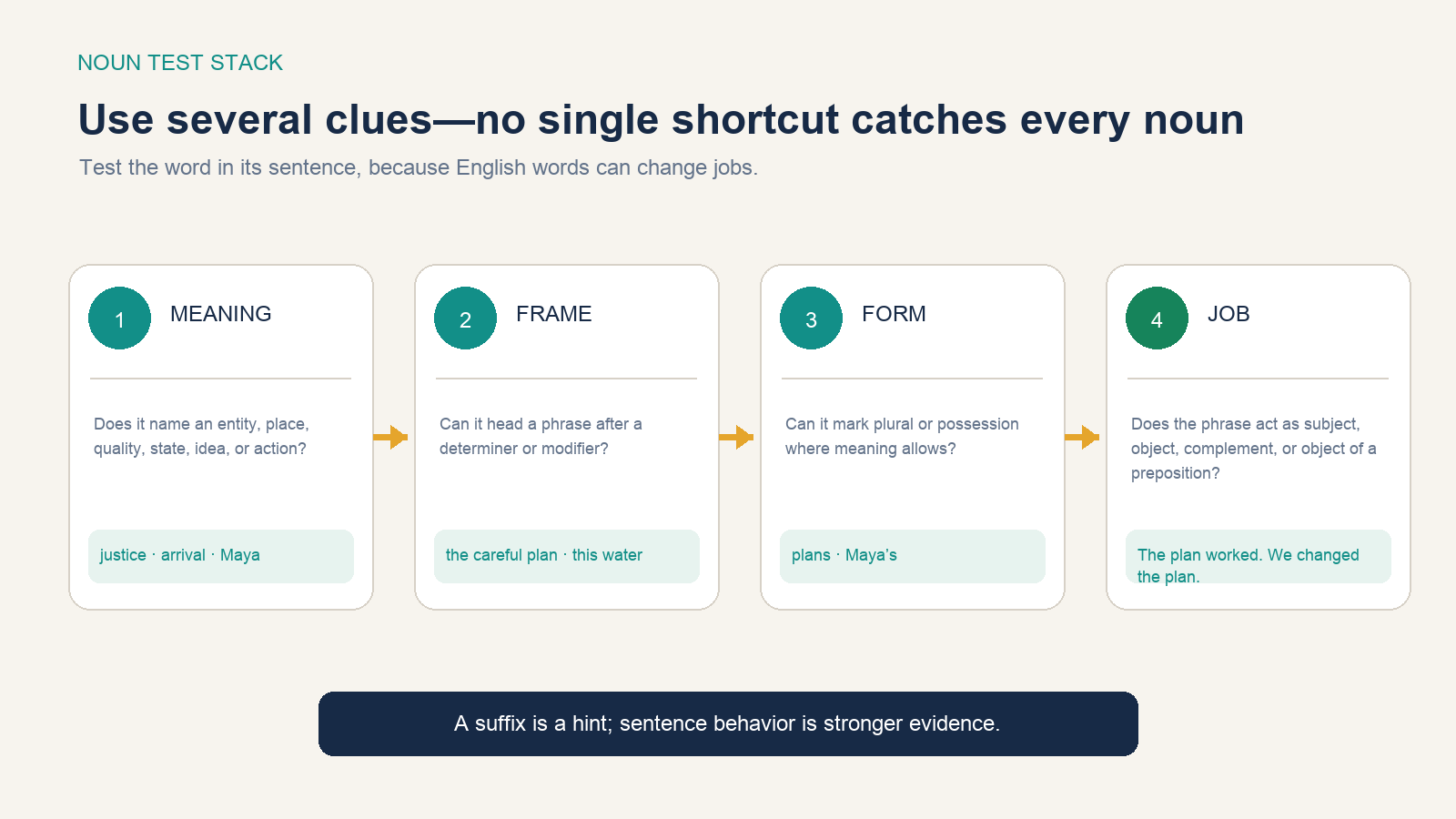
- Meaning: Does the word refer to an entity, place, substance, quality, state, idea, event, or action?
- Phrase frame: Can it head a phrase after a determiner or modifier, as in the careful plan, this water, or new information?
- Form: Can it take plural or possessive marking where the meaning permits, as in plans, students’, or Maya’s?
- Sentence job: Does the noun phrase act as subject, object, complement, or object of a preposition?
Each test has limits. Proper names do not normally need a determiner. Mass nouns such as information resist ordinary plural counting. Some nouns have irregular plurals, and some noun phrases contain several words. Treat the tests as cumulative evidence, not a four-box requirement.
Find the noun phrase, not only one word
A noun phrase consists of a head noun plus the determiners and modifiers that function with it as one unit. In those two unusually quiet rooms upstairs, rooms is the head; the whole sequence can be a subject or object.
| Sentence | Noun phrase | Head noun | Job |
|---|---|---|---|
| The final train arrived. | the final train | train | Subject |
| Rosa opened the side door. | the side door | door | Direct object |
| They elected Priya captain. | Priya / captain | Priya / captain | Object / object complement |
| We waited near the old station. | the old station | station | Object of near |
The MLA Style Center’s noun guide illustrates nouns as subjects, objects, indirect objects, complements, and objects of prepositions. It also distinguishes a noun phrase from a noun clause: a clause contains its own subject and verb, while a phrase does not.
Classify nouns along separate dimensions
Noun labels overlap because they answer different questions. Common versus proper asks whether the noun names a general class or a specific named entity. Concrete versus abstract asks what kind of referent it has. Count versus mass asks how the noun behaves with numbers, articles, and quantity words.
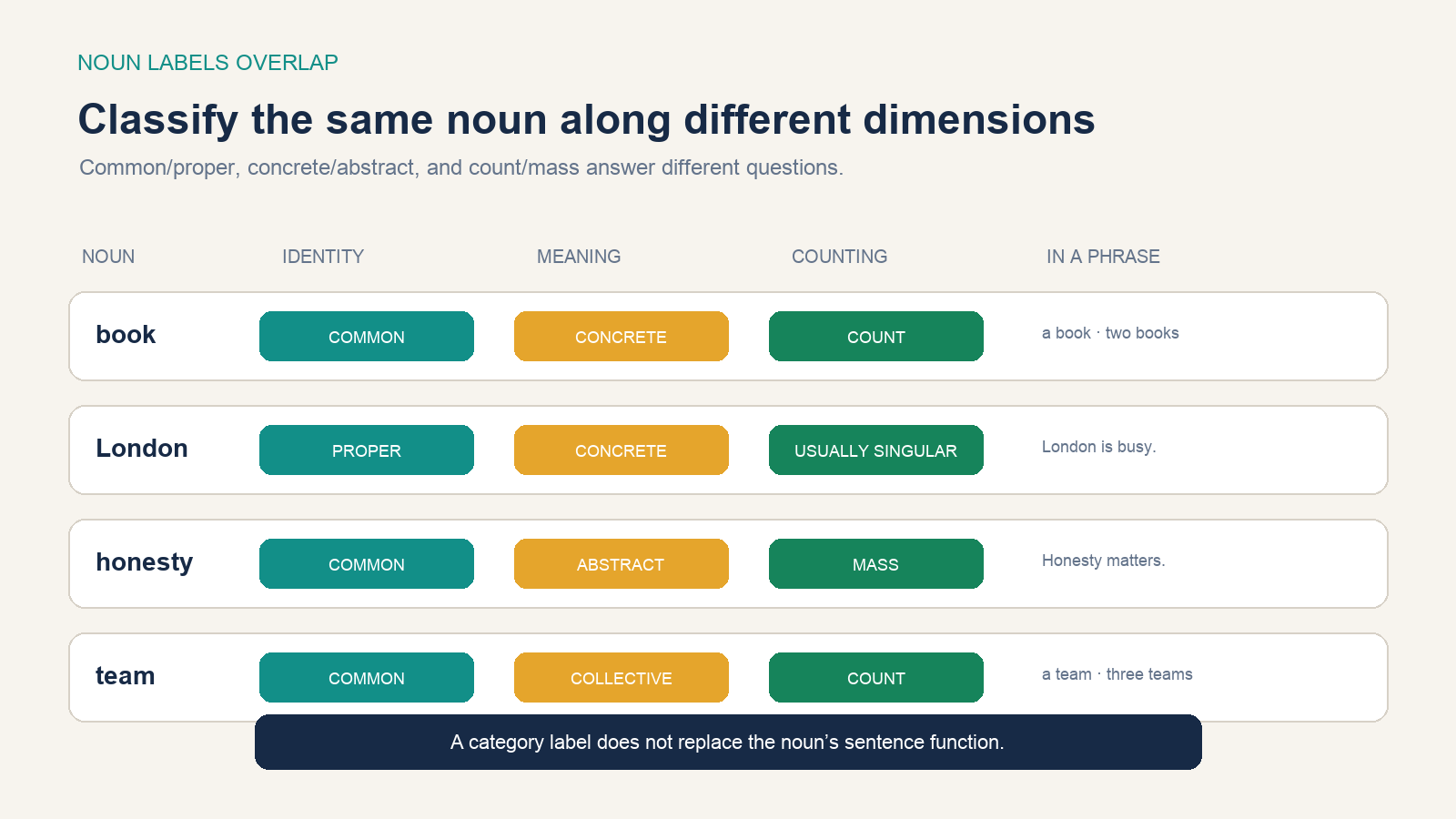
- Common noun: a general category, such as city, teacher, or month.
- Proper noun: a specific name, such as Nairobi, Dr. Chen, or August; English normally capitalizes it.
- Concrete noun: something material or perceivable, such as apple, rain, or music.
- Abstract noun: a quality, state, idea, or relationship, such as honesty, freedom, or friendship.
- Collective noun: a word for a group, such as team, audience, or committee.
These labels can depend on sense and usage. Do not force every noun into one exclusive box.
Check whether the use is count or mass
A count noun treats its referents as separate items: a report, one report, three reports, several reports. A mass or uncountable use treats something as a substance, category, or undivided concept: water, furniture, advice, research.
In standard usage, singular count nouns can take a or an; ordinary mass nouns cannot. Write a piece of advice, not an advice, and some information, not informations. Cambridge’s countability guide documents these patterns and recommends a learner’s dictionary for uncertain words.
The same spelling can change countability with meaning:
- glass = material; a glass = one drinking container.
- paper = material; a paper = an article or newspaper.
- coffee = a substance; two coffees = two servings.
- experience = accumulated knowledge; an experience = one event.
Form plurals and possessives for the right reason
Most count nouns add -s or -es for the plural: desk/desks, box/boxes. Others change spelling or remain unchanged: city/cities, child/children, sheep/sheep. A dictionary is safer than guessing an unfamiliar plural.
Possessive marking shows a relationship, not plurality. A singular noun commonly takes apostrophe + s: the student’s notebook. A regular plural ending in s commonly takes an apostrophe after it: the students’ notebooks. The plain plural students needs no apostrophe.
Do not use plural behavior as the only noun test. Proper nouns and mass nouns are still nouns even when pluralizing them would be strange in the intended sense.
Let the sentence decide the word class
Many English spellings can perform more than one grammatical job. Identify the phrase structure and sentence function instead of memorizing a word as permanently “a noun” or “a verb.” The MLA’s word-class examples show nouns used as modifiers and verb forms taking nominal, adjectival, or adverbial functions.
| Word | Noun use | Different use |
|---|---|---|
| The email arrived. | Please email the file. (verb) | |
| light | The light faded. | Carry a light bag. (adjective) |
| answer | Her answer was clear. | Answer the question. (verb) |
| school | The school reopened. | The school bus stopped. (noun used as a modifier) |
| running | Running helps me think. | They are running. (part of a verb phrase) |
Use the complete definition when the shortcut fails
Start with meaning: the word refers to a person, place, object, quality, state, idea, or action. Then look for stronger grammatical evidence: it heads a noun phrase, fits a noun phrase frame, takes noun inflection where appropriate, and lets that phrase act as a subject, object, complement, or prepositional object.
That combined test explains easy examples such as dog and Paris, but it also handles knowledge, arrival, the very last train, and words that change jobs across sentences. The noun is not defined by what it looks like; it is defined by meaning and behavior together.