

The exact gram-to-milligram relationship, two-way formulas, worked conversions, unit-cancellation checks, and high-consequence error boundaries.
1 gram = 1,000 milligrams. The relationship is exact, so the conversion factor does not need rounding.
There are exactly 1,000 milligrams (mg) in 1 gram (g). To convert grams to milligrams, multiply by 1,000. To convert milligrams to grams, divide by 1,000.
That arithmetic is simple; most bad answers come from attaching the correct digits to the wrong unit, moving the decimal in the wrong direction, or confusing mass with volume. This guide makes the unit travel with the number so the result remains auditable.
Anchor the conversion to the SI prefix
The prefix milli- means one-thousandth, or 10−3. The International Bureau of Weights and Measures SI prefix table assigns the lowercase symbol m to that factor. Attach it to gram, whose symbol is g, and the result is milligram, mg.
Therefore:
- 1 mg = 0.001 g
- 1,000 mg = 1 g
- 1 g = 103 mg
NIST’s mass-unit guidance confirms that metric multiples and submultiples of mass are formed by attaching prefixes to gram, even though the SI base unit of mass is the kilogram. You do not need a different rule because kilogram contains a prefix: milligrams are still formed from gram, not from a compound prefix on kilogram.
Convert grams to milligrams
Grams are the larger unit. Moving from a larger unit to a smaller unit produces more units, so multiply by 1,000:
milligrams = grams × 1,000
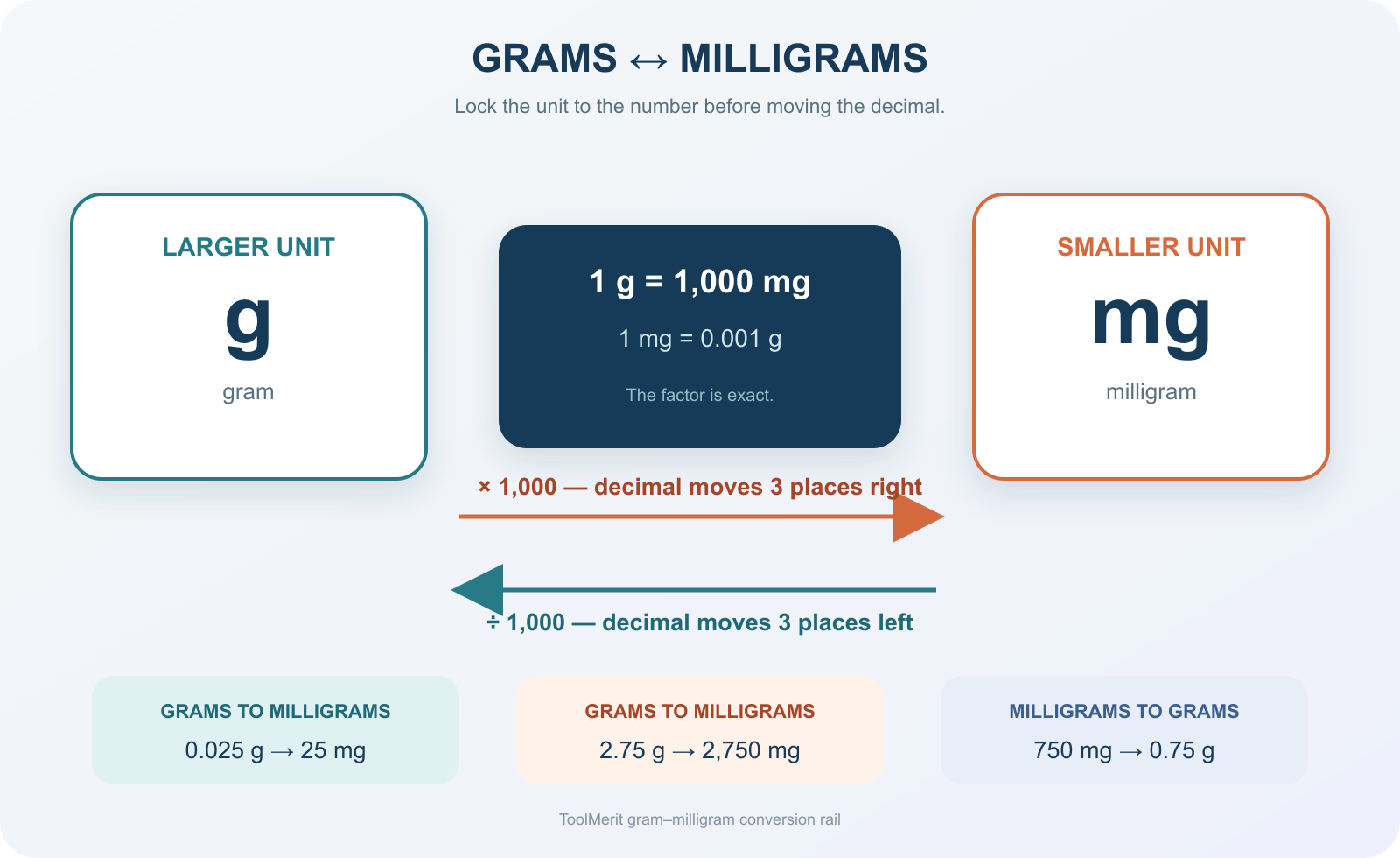
Example: convert 0.025 g to mg
0.025 × 1,000 = 25, so 0.025 g = 25 mg. Moving the decimal three places right gives the same result: 0.025 → 25.
Example: convert 2.75 g to mg
2.75 × 1,000 = 2,750, so 2.75 g = 2,750 mg. The answer must be numerically larger because milligrams are smaller pieces of the same mass.
| Grams (g) | Milligrams (mg) |
|---|---|
| 0.001 g | 1 mg |
| 0.005 g | 5 mg |
| 0.01 g | 10 mg |
| 0.025 g | 25 mg |
| 0.05 g | 50 mg |
| 0.1 g | 100 mg |
| 0.25 g | 250 mg |
| 0.5 g | 500 mg |
| 1 g | 1,000 mg |
| 2.5 g | 2,500 mg |
| 5 g | 5,000 mg |
Convert milligrams back to grams
Now travel from the smaller unit to the larger unit. The numerical value becomes smaller, so divide by 1,000:
grams = milligrams ÷ 1,000
For 750 mg:
750 ÷ 1,000 = 0.75, so 750 mg = 0.75 g.
| Milligrams (mg) | Grams (g) |
|---|---|
| 1 mg | 0.001 g |
| 5 mg | 0.005 g |
| 25 mg | 0.025 g |
| 50 mg | 0.05 g |
| 100 mg | 0.1 g |
| 250 mg | 0.25 g |
| 500 mg | 0.5 g |
| 750 mg | 0.75 g |
| 1,000 mg | 1 g |
| 2,500 mg | 2.5 g |
A fast size check catches a reversed operation: a value below 1,000 mg must convert to less than 1 g. For example, 25 mg cannot equal 25,000 g or 25 g; it equals 0.025 g.
Use unit cancellation when the decimal feels uncertain
“Move the decimal three places” is convenient, but it can become fragile when several units appear in one calculation. Write the conversion as a fraction equal to one and cancel the starting unit.
2.75 g × (1,000 mg ÷ 1 g) = 2,750 mg
The g in the input cancels the g in the denominator, leaving mg. In the reverse direction:
750 mg × (1 g ÷ 1,000 mg) = 0.75 g
This “unit-cancellation audit” proves both the operation and the output label. If the unwanted starting unit does not cancel, the factor is upside down. The same discipline helps when moving between metric and nonmetric mass units; the grams-per-pound guide shows why an exact cross-system factor requires more care than a metric prefix change.
Repair four common conversion mistakes
Mistake 1: dividing when converting grams to mg
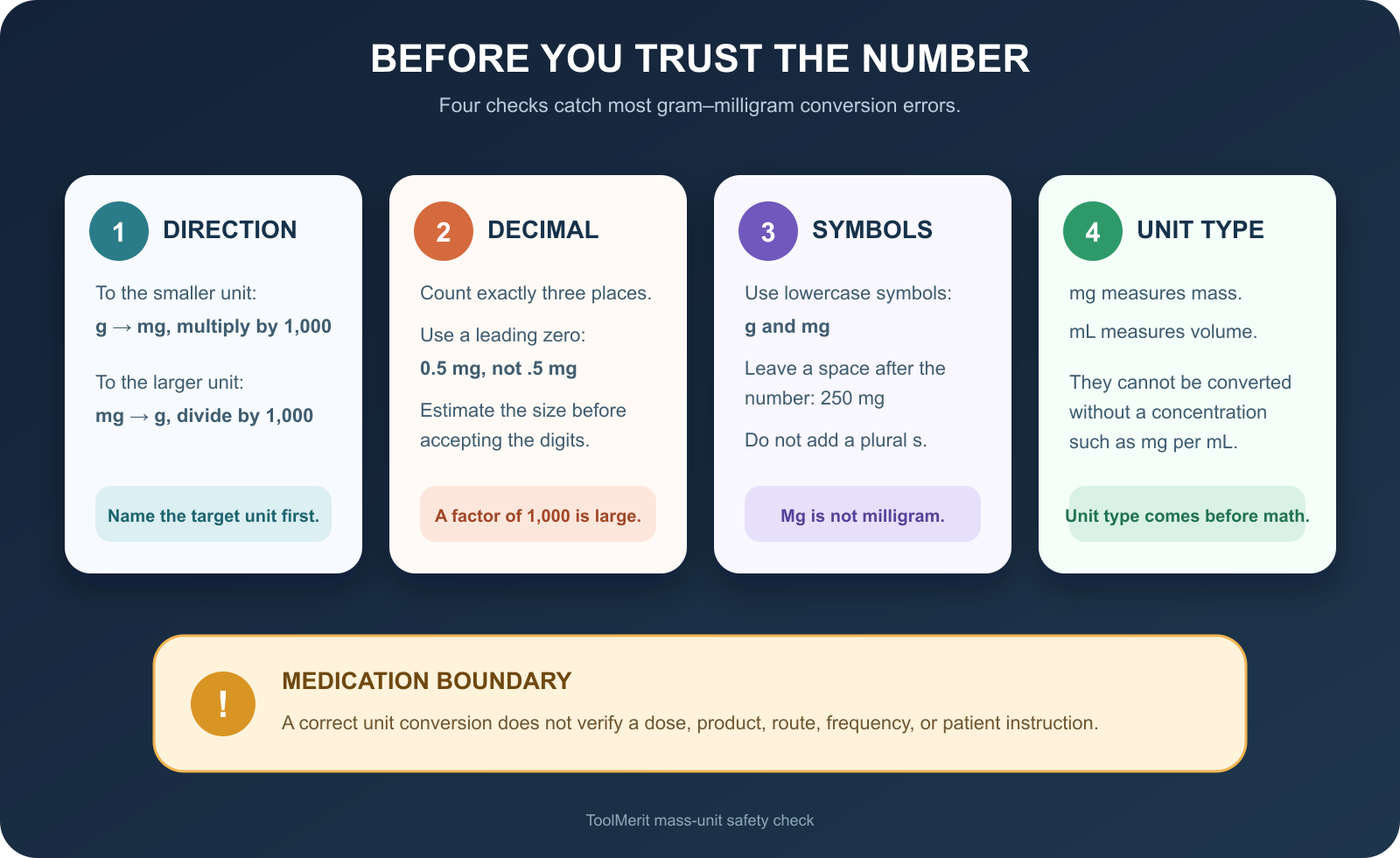
Incorrect: 0.5 g ÷ 1,000 = 0.0005 mg. Correct: 0.5 g × 1,000 = 500 mg. Ask whether the target unit is smaller. If it is, the numerical count should increase.
Mistake 2: dropping or adding the wrong number of zeros
There are three powers of ten between grams and milligrams, not two or six. Write 1.000 g before moving the decimal if the place values are hard to see: 1.000 → 1,000.
Mistake 3: changing the capitalization
mg is the milligram symbol. Mg combines the SI prefix symbol for mega, M, with g, so it represents a megagram—not a milligram. In unit notation, capitalization changes meaning.
Mistake 4: treating mg and mL as interchangeable
Milligrams measure mass. Milliliters measure volume. You cannot convert one to the other from those two units alone. A valid bridge requires a concentration or density with both units, such as milligrams per milliliter. Without that extra relationship, any direct mg-to-mL answer is missing information.
Write g and mg correctly
NIST’s SI writing guidance gives a few rules that keep values unambiguous:
- Use lowercase g for gram and lowercase mg for milligram.
- Do not insert a space or hyphen inside mg; the prefix and unit symbol form one symbol.
- Leave a space between the number and symbol: write 250 mg, not 250mg.
- Do not pluralize a unit symbol: write 5 g and 5 mg, not 5 gs or 5 mgs.
- Use a leading zero for a value below one: write 0.5 g, not .5 g.
When spelling the unit name in prose, normal English plurals apply: one gram, two grams; one milligram, two milligrams. The symbol itself remains unchanged.
Treat medication numbers as high-consequence information
A gram-to-milligram conversion checks a mathematical relationship; it does not confirm that a medication dose is appropriate. It does not verify the product, patient, formulation, route, frequency, concentration, or prescribing instruction. Use the exact label or prescription and ask a pharmacist or qualified clinician about any mismatch or uncertainty.
The Joint Commission’s medication-documentation requirements identify two decimal formats that can cause dangerous misreading:
- Use a leading zero: 0.5 mg, not .5 mg.
- Do not use an unnecessary trailing zero in medication orders: 5 mg, not 5.0 mg.
The first prevents a decimal point from being overlooked; the second prevents 5.0 from being misread as 50. These conventions matter even when the underlying 1,000-to-1 conversion is correct.
Keep the precision you actually have
The conversion factor is exact, but converting units does not improve the quality of the original measurement. If a scale reports 0.4 g, converting it to 400 mg does not make the measurement more precise; it only expresses the same measured quantity in smaller units. Preserve the source value, its uncertainty, and any required significant-figure convention in technical work.
A compact conversion record should contain:
- the original value and unit;
- the exact conversion factor;
- the unrounded arithmetic result;
- the final value, unit, and justified rounding.
For the examples above: input 2.75 g; factor 1,000 mg/g; unrounded result 2,750 mg; final reported result 2,750 mg. The unit appears at every stage.
Stop at the unit boundary
Use 1 g = 1,000 mg as the fixed anchor. Multiply by 1,000 when the target is milligrams and divide by 1,000 when the target is grams. Then check that the numerical size moved in the expected direction and that the output still describes mass.
If the task introduces milliliters, a medication instruction, or an unfamiliar uppercase symbol, stop before calculating. Those changes introduce a new relationship or a high-consequence interpretation that the gram–milligram conversion alone cannot supply.