
Convert U.S. liquid pints to cups, scale recipe fractions, and recognize the dry, Imperial, and metric cases where the two-cup rule does not apply.
There are 2 cups in 1 U.S. liquid pint. Multiply pints by 2 to get cups, or divide cups by 2 to get pints. The rule is exact when both units are U.S. customary liquid measures: one measuring cup is 8 U.S. fluid ounces and one liquid pint is 16 U.S. fluid ounces. Check the label or recipe origin before using the rule because a U.S. dry pint and a British Imperial pint are larger volumes.
That answer fits most U.S. recipes, beverage quantities, and liquid containers. It does not automatically fit a recipe that defines its cup in milliliters. Identify the measurement system before pouring; after that, the arithmetic takes one line.
First, identify which pint the recipe means
The 2026 NIST measurement tables state that one measuring cup is exactly one-half of a U.S. liquid pint. They also list liquid and dry pints separately. Use the wording, location, and package label to choose the right lane.
| What you see | Likely volume | Equivalent in U.S. cups | Best action |
|---|---|---|---|
| U.S. recipe; “pint” of milk, cream, stock, or another liquid | U.S. liquid pint: 473.176473 mL | Exactly 2 U.S. cups | Multiply the pint amount by 2 |
| Produce container explicitly marked “dry pint” | U.S. dry pint: about 550.610 mL | About 2.327 U.S. cups by geometric volume | Keep the dry-pint quantity or use the package’s volume/weight directions |
| British source or a package marked 568 mL | Imperial pint: exactly 568.26125 mL | About 2.402 U.S. cups | Convert through milliliters instead of assuming two U.S. cups |
| Recipe defines “cup” as 240 mL, 250 mL, or another value | The recipe’s stated metric volume | Depends on the stated cup | Honor that definition throughout the recipe |
The U.S. dry pint is not a different technique for measuring flour in an ordinary two-cup recipe. It is a larger dry-volume unit historically used for commodities. A container of berries can also be sold by weight or by a labeled container size, so the package—not the word pint in isolation—is the useful evidence.
The United Kingdom’s Product Regulation and Metrology Act 2025 defines a pint as 0.56826125 cubic decimeters, which is 568.26125 mL. That is about 20% more volume than a U.S. liquid pint. A British pint glass therefore does not represent two U.S. cups.
Convert any U.S. liquid-pint amount with a factor of two
Cups = U.S. liquid pints × 2

U.S. liquid pints = cups ÷ 2
For 1.75 pints, multiply 1.75 by 2:
1.75 pt × 2 cups/pt = 3.5 cups
The unit pt cancels, leaving cups. For the reverse direction, 5 cups divided by 2 equals 2.5 pints. You can use decimal or fractional inputs; the factor does not change.
- One quarter pint: 1/4 × 2 = 1/2 cup.
- One third pint: 1/3 × 2 = 2/3 cup.
- One half pint: 1/2 × 2 = 1 cup.
- Three quarters pint: 3/4 × 2 = 1 1/2 cups.
- Two and one quarter pints: 2 1/4 × 2 = 4 1/2 cups.
For repeated conversions, put the pint quantity in one spreadsheet cell and use =A2*2 for cups. Name the input column “U.S. liquid pints” so a future collaborator does not feed an Imperial or dry-pint value into the same formula. ToolMerit’s tool tutorials cover other ways to make small calculations repeatable.
Read common pint amounts at a glance
This table keeps both the mathematical result and the physical pour visible. Use standard graduated measuring cups rather than drinking cups, whose capacities are not standardized.
| U.S. liquid pints | U.S. cups | One practical way to measure it |
|---|---|---|
| 1/8 pint | 1/4 cup | One 1/4-cup measure |
| 1/4 pint | 1/2 cup | One 1/2-cup measure |
| 1/3 pint | 2/3 cup | Two 1/3-cup measures |
| 1/2 pint | 1 cup | One full cup |
| 3/4 pint | 1 1/2 cups | One cup plus one 1/2 cup |
| 1 pint | 2 cups | Two full cups |
| 1 1/2 pints | 3 cups | Three full cups |
| 2 pints | 4 cups | One quart or four cups |
| 3 pints | 6 cups | One quart plus two cups |
| 4 pints | 8 cups | One half-gallon |
A fast plausibility check catches most calculator mistakes: the number of cups should be twice the number of U.S. liquid pints. If 0.5 pint produces 4 cups, or 3 pints produces 1.5 cups, the operation was reversed or another unit slipped into the input.
Scale the recipe in two separate moves
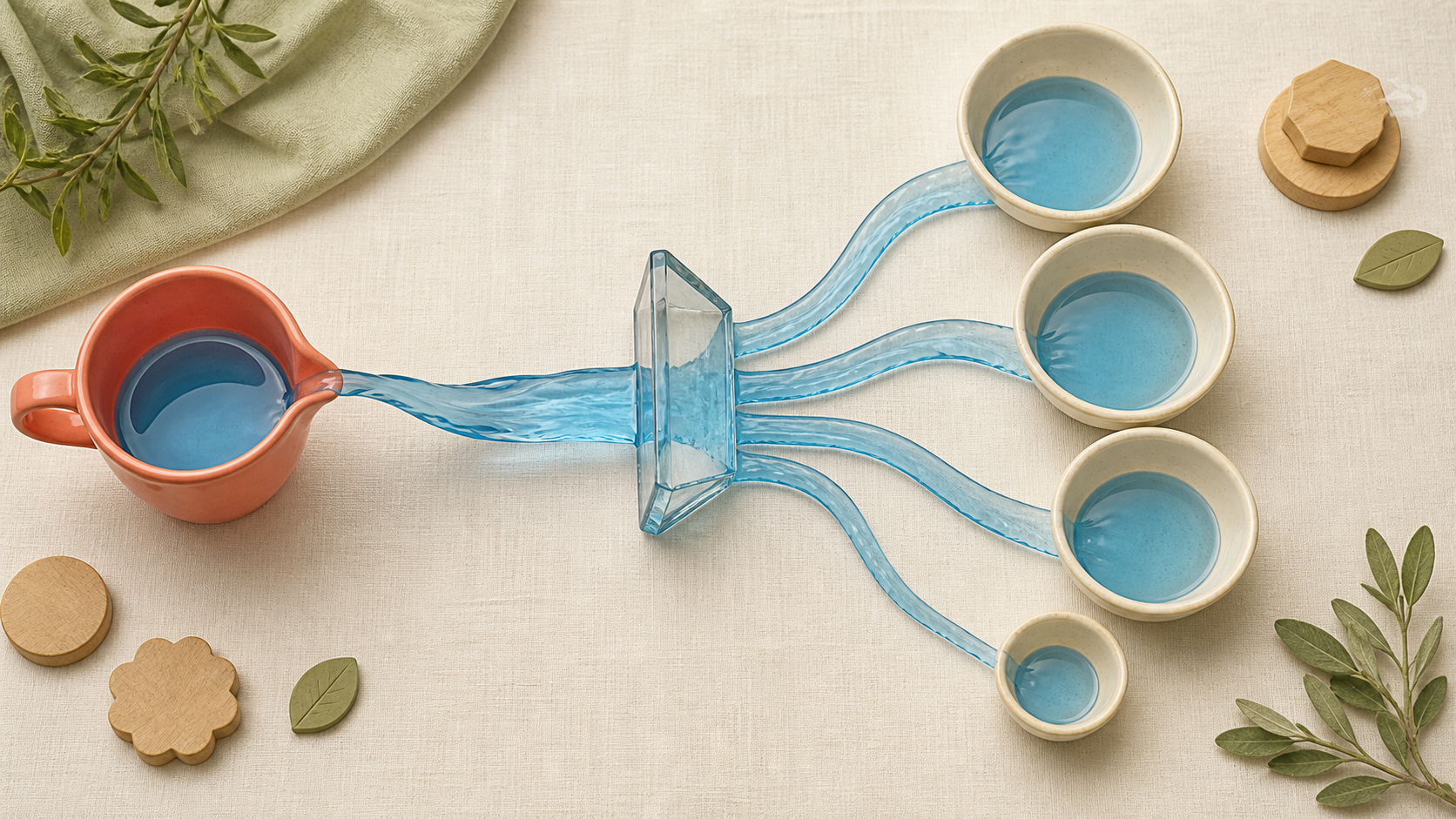
When a recipe uses a pint fraction and you are making a fractional number of batches, separate the unit conversion from the batch scaling. This prevents two different multipliers from becoming one opaque calculator entry.
Suppose one batch of soup requires 3/4 pint of stock, and you need 2 1/2 batches.
- Convert the one-batch amount: 3/4 pint × 2 = 1 1/2 cups.
- Scale the converted amount: 1 1/2 cups × 2 1/2 batches = 3 3/4 cups.
Per batch:  0.75 pt × 2 = 1.5 cups
Full run:   1.5 cups × 2.5 = 3.75 cups
Measure:    3 cups + 3/4 cup
Keep the unrounded value until the final measuring step. Here, 3.75 cups maps cleanly to 3 3/4 cups. If a calculation produces a hard-to-measure result such as 3.68 cups, converting to milliliters may be more reliable than trying to judge the level between cup markings. A general-purpose converter from ToolMerit’s free tools can help with the arithmetic, but the recipe’s unit system still has to be chosen by the cook.
A second useful check is yield. If a 3-pint container holds 6 U.S. cups and each planned portion is 2/3 cup, the theoretical yield is 6 ÷ 2/3 = 9 portions. Real serving loss, residue, or uneven ladling can reduce the practical yield, so do not promise nine full portions unless the process controls those losses.
Use milliliters when a recipe crosses measurement systems
Cups can look universal while hiding different volumes. Milliliters provide a neutral bridge: first convert the source amount to mL, then divide by the destination cup size.
Destination cups = source volume in mL ÷ destination cup size in mL
| Source quantity | Source volume | Destination cup | Result |
|---|---|---|---|
| 1 U.S. liquid pint | 473.176473 mL | U.S. cup: 236.5882365 mL | Exactly 2 cups |
| 1 U.S. liquid pint | 473.176473 mL | Recipe-defined 250 mL cup | About 1.893 cups |
| 1 Imperial pint | 568.26125 mL | U.S. cup: 236.5882365 mL | About 2.402 cups |
| 1 Imperial pint | 568.26125 mL | Recipe-defined 250 mL cup | About 2.273 cups |
NIST’s high-precision volume factors give 236.5882 mL for a U.S. cup, 473.1765 mL for a U.S. liquid pint, and 550.6105 mL for a U.S. dry pint. Those rounded display values preserve the important differences among the units.
For home cooking, NIST’s Metric Kitchen chart deliberately uses convenient approximate equivalents: 240 mL for one cup and 480 mL for one pint or two cups. That is a sensible recipe-level approximation, not a new exact definition. The FDA likewise sets one cup to 240 mL for nutrition-labeling purposes in 21 CFR 101.9. A Nutrition Facts serving-size convention should not silently replace the units specified by a recipe.
Keep volume separate from ingredient weight
Pints and cups measure volume. Grams and ounces without the word fluid measure mass. You cannot convert two cups into one universal gram value because equal volumes of water, flour, honey, and chopped vegetables have different masses.
If a recipe needs grams, use an ingredient-specific weight supplied by the recipe author, a reliable food database, or a scale. Do not search for a generic “cups to grams” factor and apply it to every ingredient. Even within one ingredient, packing method, particle size, moisture, and aeration can change how much mass fits into a cup.
The same distinction explains why a dry pint is not a weight. It specifies container volume, not how many ounces or grams of berries, tomatoes, or another commodity are inside. When purchasing for a recipe, use the product’s net-weight label if the recipe asks for weight; use the container volume only when the recipe asks for volume.
Make the kitchen measurement reproducible
Choose a liquid measuring cup for pourable ingredients, set it on a level surface, and read the marked line at eye level. Use the measurement convention required by the recipe or package. If the vessel has both U.S. cup and milliliter markings, stay on one scale for the whole calculation instead of switching back and forth with rounded values.
Before adding the ingredient, record three items on a shared recipe or production note:
- the source quantity, including the word liquid, dry, or Imperial when relevant;
- the conversion used, such as
0.75 U.S. liquid pint × 2 = 1.5 U.S. cups; - the final measuring instruction, such as “pour to the 1 1/2-cup line” or “measure 355 mL.”
That small notation is especially useful when a recipe moves between writers, kitchens, or software systems. ToolMerit’s directory of collaboration tools can help teams choose where to keep approved recipe versions and unit notes.
For a U.S. liquid recipe, the finished rule remains simple: one pint is two cups. The conversion is ready when the pint system is named, the factor matches that system, and the final cup or milliliter amount can be measured without guessing.